DANCES WITH DOPES

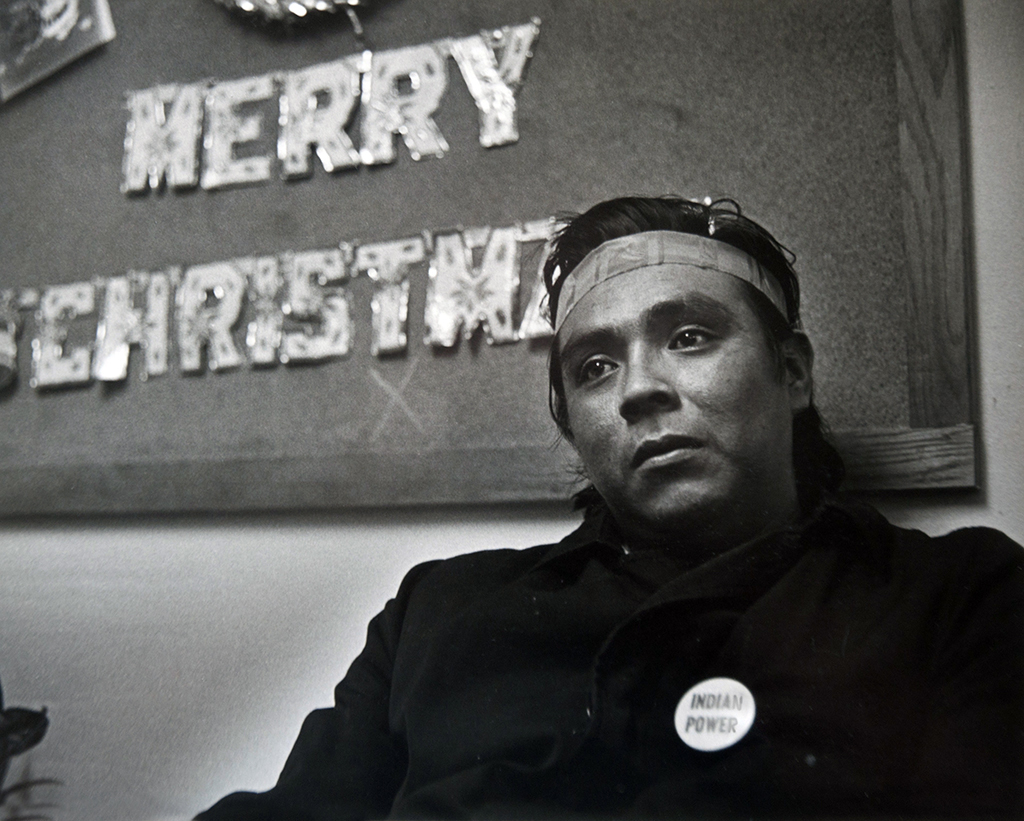
Marvin (Pima native), A.I.M. (American Indian Movement) takeover of the B.I.A.
(Bureau of Indian Affairs office), Chicago, March 23, 1970

Text and Photograph by Bruce Berman

I was having a pretty good year when I was 23.
What the heck… worked in a camera store, the boss let me buy a Canon QL camera at cost, there was built-in “subject matter” everywhere. This was the aftermath months of MLK’s assassination, the riotous 1968 Democratic debacle, Bobbie’s takedown,
in L.A. and rthe rise of the SDS Weathermen.
Even if, as a beginning photographer, I didn’t know what to shoot or even, really, how to (let alone was just beinning to get some chops down in print production in the darkroom), there was always something happening.
Marvin was a guy I had met at an inti-war demonstration in Lincoln Park earlier in the year. He called me and informed me he was part of a group that was going to do a demonstration at the Midwest Regional office of the B.I.A. (Bureau of Indian Offices). He asked if I could come down and make some photographs.
March 23, 1970: Activists in Chicago staged a massive sit-in alongside protests at five other BIA regional offices across the country to demand that the federal government provide services to Natives living off reservations. These localized Chicago demonstrations paved the way for larger actions, including the 1972 Trail of Broken Treaties which culminated in the takeover of the national BIA headquarters in Washington, D.C
Specifically, he said, “… I think all hell’s gonnna break out and it would be great to have some pictures.”
I pondered that. Did I want to be in the middle of a breakout of hell?
Continue Reading

POLISH GYM SHOES, 1971

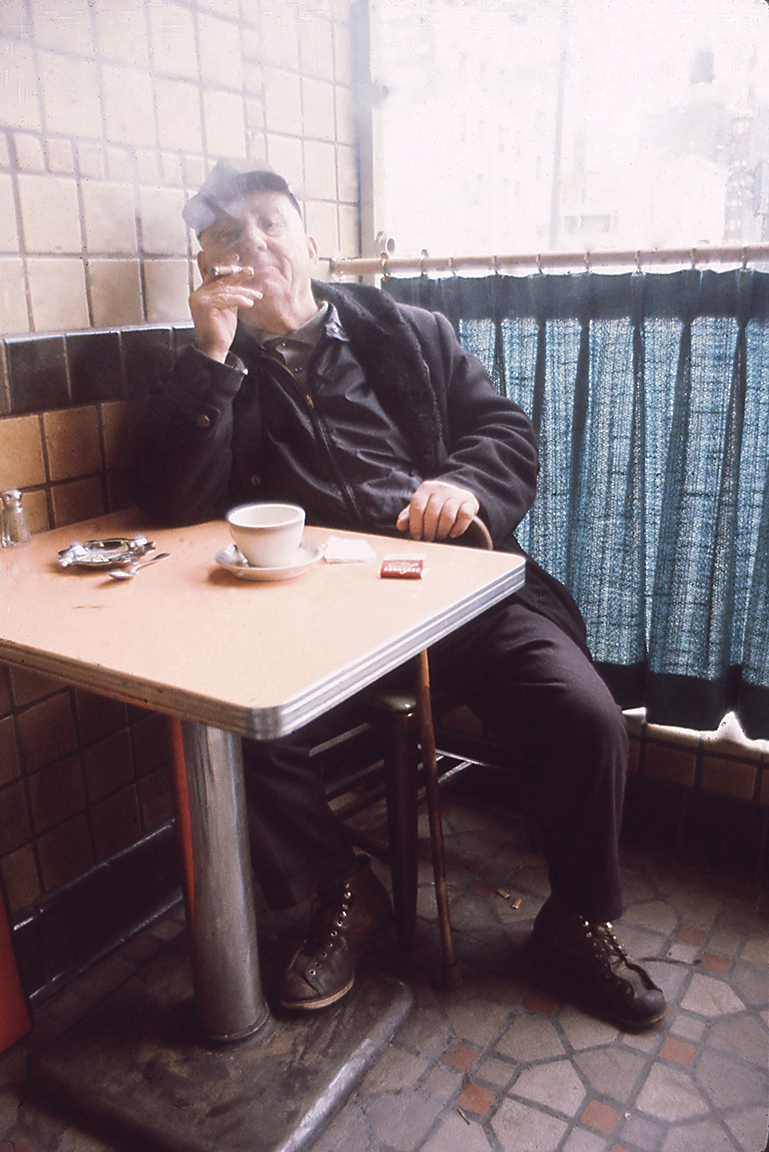
Smoking Man, diner at State and Ohio Streets, Chicago, 1971

Photograph and Text by Bruce Berman

This was the very beginning of my career, when I first realized what I wanted to be … a photographer. Not much has changed since then. This is exactly the kind of photograph I like to make, the kind of experience I like to have. Me on the prowl, encountering a person on the fringe, direct eye contact. The only thing I do now that I did not do then is to get more info about a person, really get to know them. At that time, and for many many years afterwards, I was just satisfied with getting the photograph. As time has gone on I now realize that that is incomplete. It’s the photograph and the text that matter, so that the person photographed is honored, not just used. Maybe that reflects aging, learning the world is not all about me but about me being in the world, about respect for others, maybe just about being a real documentary photographer.
So, here I am, 42 years later and I don’t know who he is, where he was from, what the name of the diner was, what he did for a living, exactly when the date was, etc., i.e., the 5Ws that any journalist knows are essential.
A detail I never noticed before, is his shoes. Believe it or not they are meaningful to me. In my old south side neighborhood, these are the kind of shoes we’d buy every few years. They were our main shoes (except for dress shoes). This man’s are the primos, the better ones, because they have finished leather. Ours were the exact same 10 lace model but a cheaper brand, and the leather on those was called “rough out.”
Why am I talking about shoes?

Continue Reading

FSA, MINORITIES, AND FAKE NEWS

Article by Bruce Berman

The Atlantic Monthly just published an article about the FSA (Farm Security Administration) and how minority Americans (African-Americans and Latino Americans) were ignored by the FSA during its four year run.
It’s title is: Whitewashing the Great Depression.
It is factually misinforming.
Four years ago I co-authored (with my colleague Dr. Mary Lamonica) an article titled, “The Photographer as Cultural Outsider.”
It focused on Russell Lee and his 1949 project shot for George I. Sanchez who was the first Latino Dept. Head at UT-Austin and one of the early Civil Rights warriors in LULAC (League of United Latin American Citizens). Sanchez had created The Study of the Spanish-Speaking People of Texas project. Lee, of course, was an FSA shooter of great renown and prestige (and later OWI/Office of War Information). He had settled after his WW 2 service in Austin, Texas, the same city as Sanchez’.
Our article was a little more nuanced than the Atlantic piece and delved into the issue of cultural identity of the photographer (or writer or filmmaker) in shaping not only his/her viewpoint but how various ethnic subjects react to a photographer.

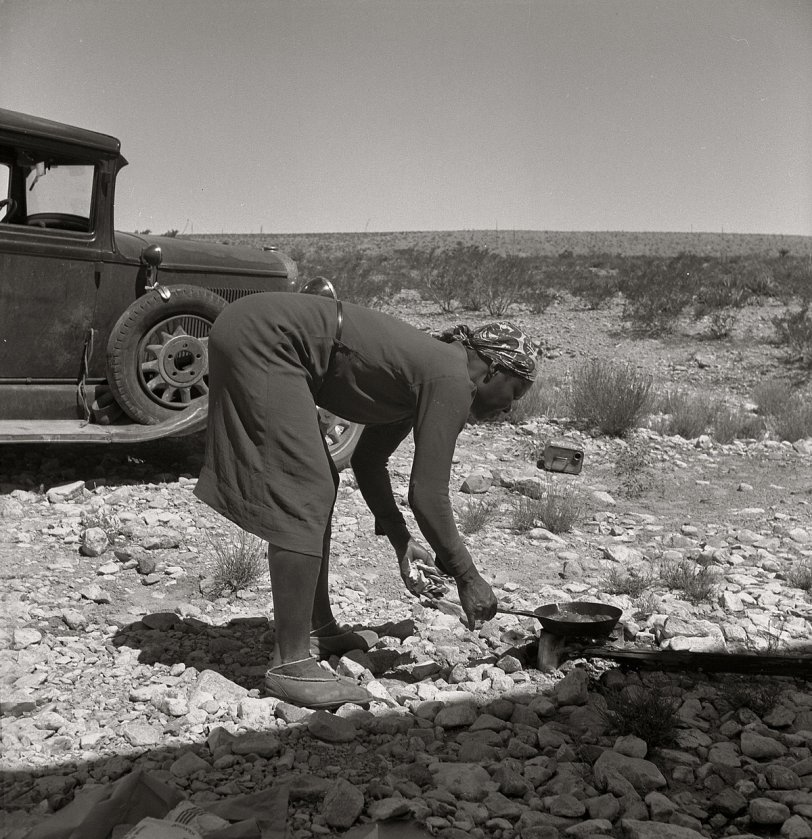
June 1938. Outskirts of El Paso, Texas. “Young Negro wife cooking breakfast. ‘Do you suppose I’d be out on the highway cooking my steak if I had it good at home?’ Occupations: hotel maid, cook, laundress.” Medium-format nitrate negative by Dorothea Lange for the FSA (Farm Security Administration).
Continue Reading

EVIL EYE


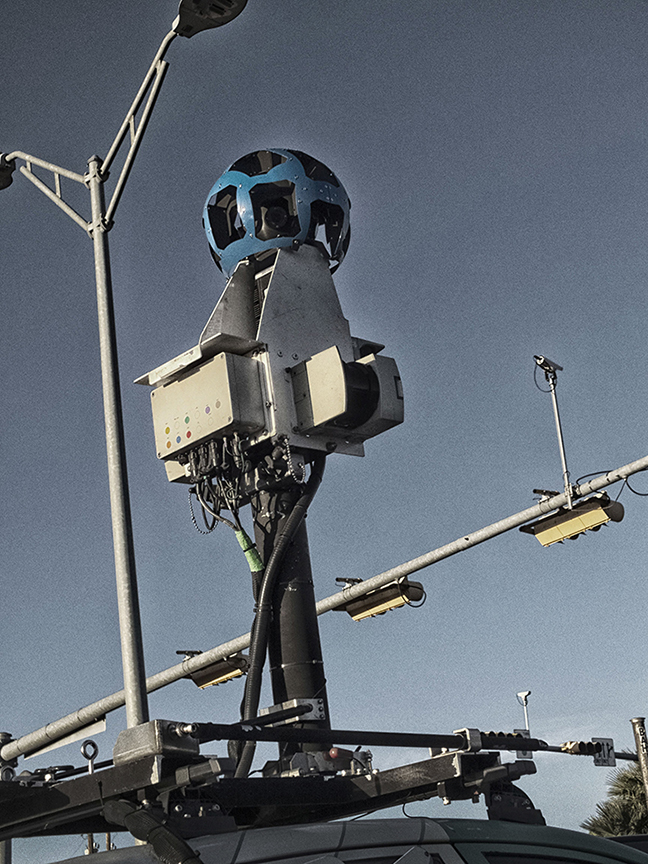
Evil Eye (of Google), El Paso, Texas, 2018


If a dude you don’t know was in front of your casita taking pictures, wouldn’t you go out and ask him/her what they’re doing? Would you not feel righteous indignation (your home is your castle…. why is this cat snapping photos of my castle?)?

Why does Google have a right to drive up and down the streets of this world taking pictures of your home? Who made a law making that alright? Where does this end? Is there an X-Ray camera that can penetrate the outside of your home and looks at your inside? When does that machine get arms and legs and jump down and punishes you -inside or out- for what they think is a “transgression? Is that OK for Google to do? Or the Government? Or your worst enemy? Or the local pervert?

Who is this OK with?

Continue Reading